

|
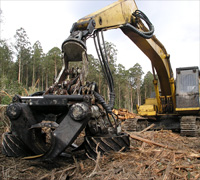
the forests of Tasmania as yet unsullied and polluted by our kind of civilisation. That we should have to defend them is something quite unbelievable." Sir Yehudi Menuhin (1979) Patron of the Wilderness Society For more info on the life and achievements of Sir Yehudi Menuhin, see http://www.bach-cantatas.com/Bio/Menuhin-Yehudi.htm or http://www.menuhin-foundation.com/ People often ask why Tasmanians keep risking everything to fight for their wilderness heritage? Well here are just a few reasons. The key to understanding the Tasmanian forestry debate is realising that the current regime of industrial forestry has created massive demand for timber consumption and turnover. Industrial forestry is very highly mechanised and, as a consequence, is low in employment. Profit is the prime motivation. Once a native forest ecosystem is flattened, burned and poisoned by the loggers, it's NEVER the same again. It's either replaced with a monoculture tree plantation, or reseeded with native species. Either way, it is an industrial forestry zone from that time onwards and is re-logged before it can have the time to grow back to anything like its former glory.
...and the Glory. - the world's tallest flowering plant,
the giant Eucalyptus regnans growing to 90 metres high, Another aspect of Tasmania that remains back in the ice age, is a political process that churns out policies that are contributing to the destruction of some of Tasmania's most precious areas of wilderness, to benefit the industrial logging industry. Woodchips, woodchips, woodchips!
According to Forestry Tasmania, the Tasmanian government's own forestry arm, in its 2002-03 annual report, over 82.3% of all logs extracted from native forests on public land become woodchips. This figure doesn't include woodchips produced from sawmill residues. Most woodchips are extracted by the clear felling and destruction of tall eucalypt forests containing rich biodiversity. Unfortunately many of these magnificent forests are not included in national parks despite the recommendation of many eminent scientists and the expressed will of the Tasmanian people. The woodchip state
The royalty rate for raw material (timber) charged by the Tasmanian government to private industrial forestry companies is truly pathetic: as little as $14 dollars a tonne. That's an appallingly low price for the permanent and catastrophic loss of our environmental heritage. These same wealthy, privately owned woodchip corporations can sell woodchips for around $72 a tonne! Not even rainforest is spared! According to the Tasmanian Forest Practices Board's annual report for 2002-03, Tasmania has cleared over 5000 hectares of rainforest since 1996. Tasmania is the only Australian state, and one of the few places in the world, to clear and woodchip rainforest species. Poisoning of native wildlife Tasmania is almost unique in poisoning its native fauna with a cruel toxin called 1080 (Sodium monfluoroacetate), to benefit industrial forestry.
"Collateral damage", in the form of poisoning non-target species, is serious in view of Tasmania's role as a refuge for mammals such as the famous Tasmanian Devil (now extinct in mainland Australia), the Spotted Quoll (listed as "vulnerable" under the threatened species list), and the Eastern Quoll (now considered extinct on mainland Australia). There's no way of preventing these unique carnivorous marsupials from feeding upon poisoned carcasses. Eating poisoned carcasses can affect these creatures in ways as yet unknown. It could kill them, or weaken them in such a way that they are more easily preyed on by other carnivores or made prone to disease. Other native creatures known to be affected, include birds and wombats, and may include birds such as the majestic wedge-tailed eagles, of which there are under 200 breeding pairs in Tasmania. Many are calling for sound research on 1080, but it is felt that this can't happen, because the evidence regarding the effects on non-target species in particular, and 1080 in general, simply hasn't adequately been collected to satisfy the rigours of science. Possible harm to the Tasmanian Devil? We don't know how 1080 poison is affecting
the Tasmanian Devil, which is very serious in view of the species'
current dire predicament with the outbreak of a fatal facial
tumour. This disease is affecting a big percentage of the State's
devil population and there are now grave fears for the species'
survival. A glimmer of hope? Due to years of sustained public pressure and international embarrassment, the fiercely pro-wood chipping Tasmanian government has moved ever so slightly. This cruel, barbaric practice will cease in publicly owned forests at the end of 2005, however it will continue in private forestry areas that cover a huge area of Tasmania. Gunns and 1080 The Plantation Forests Issue Plantation forestry in Tasmania has replaced a massive area of native forests specifically clear felled for the purpose of its establishment. It has also replaced vast tracts of valuable farmland. The plantation forestry rollout has raced ahead of good scientific research on the integrity of the geo-hydrology of plantation areas, changing weather conditions, waterways and catchments, changing rainfall patterns and integrity of adjacent native forest types. Plantations must be sprayed with insecticides and herbicides. Given that many waterways in Tasmania contain drinkable, fresh water, this is of particular concern for native animal and invertebrate health, not to mention human health, given that the plantation roll out has now come close to many residential areas. It is our understanding that local Waterwatch groups do not have the ability, funding and technology to do baseline and ongoing testing of waterways for agricultural pesticides and herbicides. Tasmania has a vigorous organic farming community, and the issue of chemical trespass from adjacent plantations is a very real one, with the associated risk of loss of organic registration. Keep remembering that most of the problems above are related to massive demand for, and turnover of timber required to feed the huge appetite of highly mechanised industrial forestry. Plenty of alternatives have been put forward allowing a timber industry that is low in volume and turnover, as well as high in employment. See Timber Workers For Forests www.twff.com.au and the Protecting Forests - Growing Jobs report for such viable alternatives.
|
© 2005 Gunns20.org
 What's at stake?
 The
Power
The
Power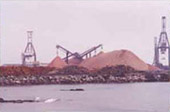 The
Tasmanian timber industry is predominantly woodchip driven.
The
Tasmanian timber industry is predominantly woodchip driven.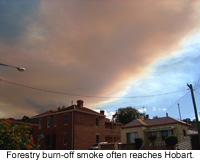 Tasmania produces more woodchips than the total
for all other Australian states. While the current total wood
chipping levels are now shrouded in government secrecy, the Australian
Bureau of Statistics said that Tasmania wood chipped an astronomical
5.3 million tonnes in 2000!
Tasmania produces more woodchips than the total
for all other Australian states. While the current total wood
chipping levels are now shrouded in government secrecy, the Australian
Bureau of Statistics said that Tasmania wood chipped an astronomical
5.3 million tonnes in 2000!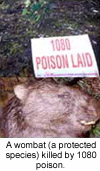 In Tasmania,
1080 poison is used to target native marsupial animals that can
browse on seedlings that grow after native forest clear felling,
or seedlings planted in industrial forestry plantations.
In Tasmania,
1080 poison is used to target native marsupial animals that can
browse on seedlings that grow after native forest clear felling,
or seedlings planted in industrial forestry plantations. 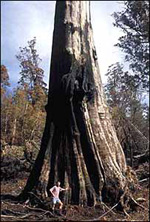 The
Death of El Grande
The
Death of El Grande